


- 8,718UK PFS sitesApproximate market size
- 6Customer segmentsFrom micro independents to oil majors
- <6 moDiscovery to MVPDesign Thinking delivery
The challenge
Six segments, one product direction
There are approximately 8,718 Petrol Filling Stations in the UK market. Early research segmented six distinct customer groups, each with different characteristics.
Retailers lacked the data and know-how to price with confidence and maximise margin across portfolios. The MVP had to add financial value through data intelligence without overwhelming the least-supported segments.
The Challenge
There are approximately 8,718 Petrol Filling Stations (PFS’s) in the UK market. Early research segmented 6 distinct customer groups each with different characteristics.
- Large Independent020.8%
- Medium Independent05.5%
- Grocers015.0%
- Oil Companies05.7%
- Micro & Small Independent053.0%
A Design Thinking approach
From discovery to a Minimal Viable Product
Starting at the earliest discovery stage with a new start-up, the Palladium Product & Service Design team led a Design Thinking approach (empathise, define, prototype and test) to deliver a Minimal Viable Product into the hands of petrol retail customers in less than six months.
I was the sole UX designer on an Agile Product and Service Design Team that comprised of a Service Design Director, Product Manager/Scrum Master and four developers. I was responsible for determining the overall design direction of the project, while collaborating with the rest of the team on all stages of the Design Thinking Process.
Empathise
Understanding six customer segments
The first stage of the Design Thinking process involves developing a sense of empathy towards the people you are designing for, to gain insights into what they need, what they want, how they behave, feel, and think, and why they demonstrate such behaviors, feelings, and thoughts when interacting with products in a real-world setting.
Critical to our design process was the close partnership we formed with a small test group of users in the "Small Independent" customer segment. This facilitated rich behavioural insights into the least supported group in all modes of the Design Thinking process.
User interviews & workshops
Workshops with the start-up CEO, CTO and Product Manager were carried out to understand the business requirements in detail. 1:1 interviews with each of our five segmented customer groups of potential platform users were carried out.
Ethnography
Our friendly retailers, Raj, Tony and Jay were prepared to engage in "Day in the life" on-site studies in the discovery, testing, prototype and MVP stages.
Journey mapping
Understanding users' journeys and satisfying and unsatisfying experiences with current tools.
Define
Synthesising observations into problem statements
The purpose of this stage of the process is to define the core problems (problem statements) from a human-centred point of view that you will tackle in the subsequent ideate phase. This is achieved by analysing and synthesising all the observations we have gathered in the Empathise phase.
Through our user research we were able to identify pain points and common themes. Overlaid by the business objectives and a five-year strategy, our minimal viable product focused on three key themes: adding financial value (add financial value for petrol retailers by using data intelligence to optimise volume sales and margin), improving productivity (save retailers' time with a convenient and intuitive platform that addresses many needs in a "one stop shop"), and providing transparency (build trust by providing light with an independent source of reliable, accurate and complete market and site information).
Ideate
Rapid experimentation and iteration
Having gained a good understanding of our users from the Empathise stage, analysed and synthesised these observations into human-centred problem statements in our Define stage, we were now ready for the divergent phase of ideation.
Collaborative ideation workshops with the product team and our target personas were stimulated by "How might we?" questions based on our Problem Statements.
We estimated and prioritised our Product Backlog using DEEP principles. Our Product Manager defined acceptance criteria for testing and pumped User Stories into JIRA for bi-weekly design sprints (usually two weeks ahead of development). Daily retrospective sessions enabled the team to monitor progress and improve the approach for future sessions and/or design sprints based on individuals' personal views and expectations.
Prototype
From rough sketches to high-fidelity mockups
Rough sketching, task flows and wireframes progressed in fidelity as we gained confidence from continual testing.
Before diving into any prototype, I will iterate simple task flows to optimise the key user journeys and minimise friction. These would be fleshed out in collaboration with the business and technical teams for feasibility.
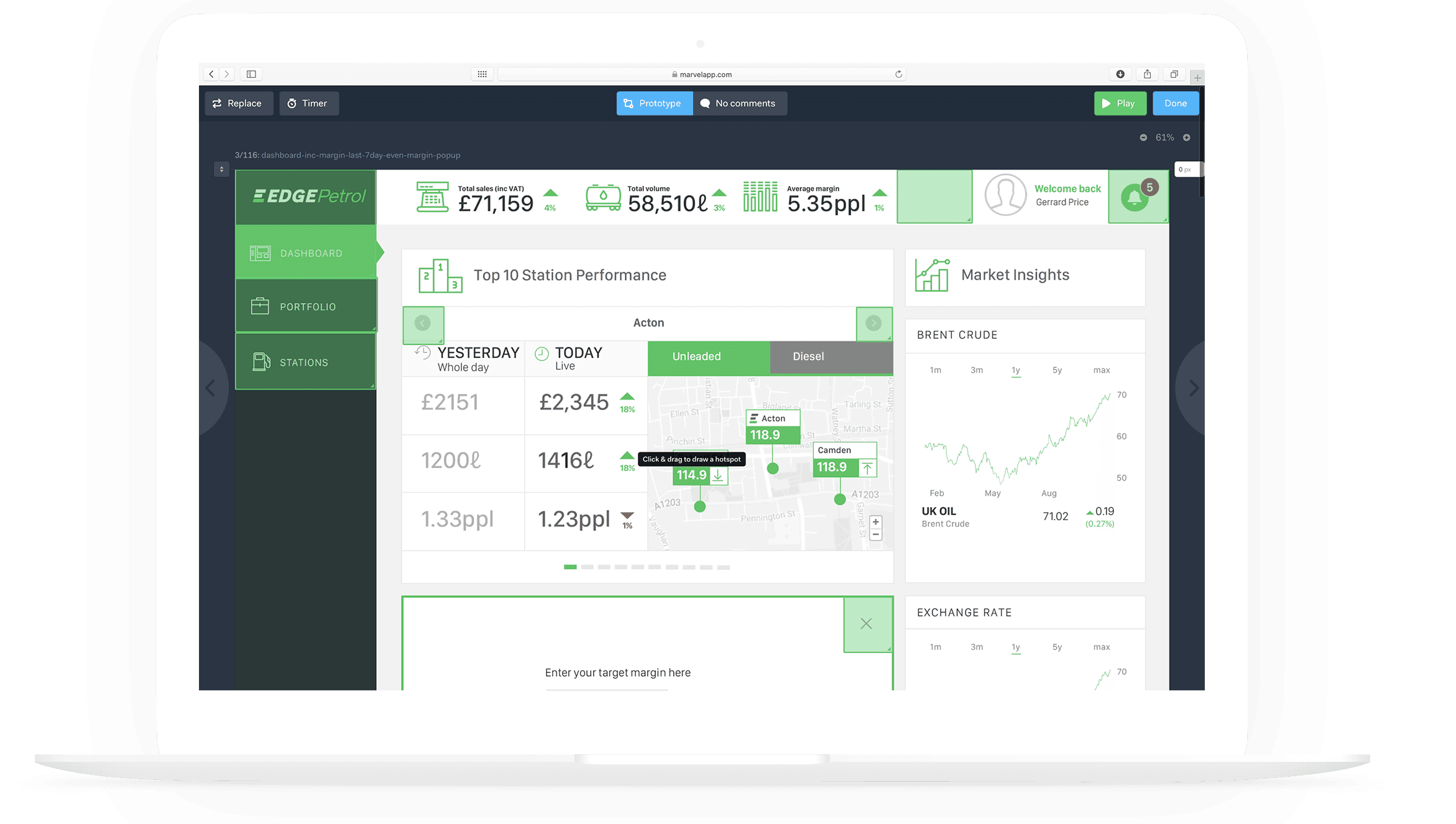
Early, low investment, black and white wireframes quickly came to life as interactive prototypes using Marvel. The Marvel App is a rapid prototyping tool that synchronises your Sketch workflow with an interactive cloud-based prototype you can share and test with your users. Its interactivity is basic but an invaluable tool for fast feedback in the early stages.
Test
Validation throughout the process
Testing is undertaken throughout the process of a Design Thinking project. A range of methods were employed at different times, appropriate to our level of understanding of the problem.
As a user story was developed through the process, from defining its acceptance criteria to possible solutions, I would share my designs or prototypes with the team in each sprint review for User Acceptance Testing. The client stakeholder (CTO), Product Manager and developer/QAs in attendance would feedback to ensure each iteration met the acceptance criteria.
For me, the most effective and accessible user testing technique prior to development was the "Thinking Aloud" usability test. Placing our friendly test users in front of one of my clickable prototypes, I would ask them to share their views on their overall feeling while using the app, usability, pain-points and areas where they were confused or frustrated.
In both the latter testing stages of the MVP and post its official release, HotJar provided a unique window into our product in use on a daily basis. This data that we obtained "in the wild" was some of the most revealing and formed an invaluable bank of research for the subsequent Phase 1.0 release.
Impact
MVP launch and business growth
After the MVP launched, we continued collecting stories from our users and gathering feedback. Comparing the stories we collected at the early stages of the project with those after launch revealed the positive impact that our solution made on the lives of our Petrol retailers.
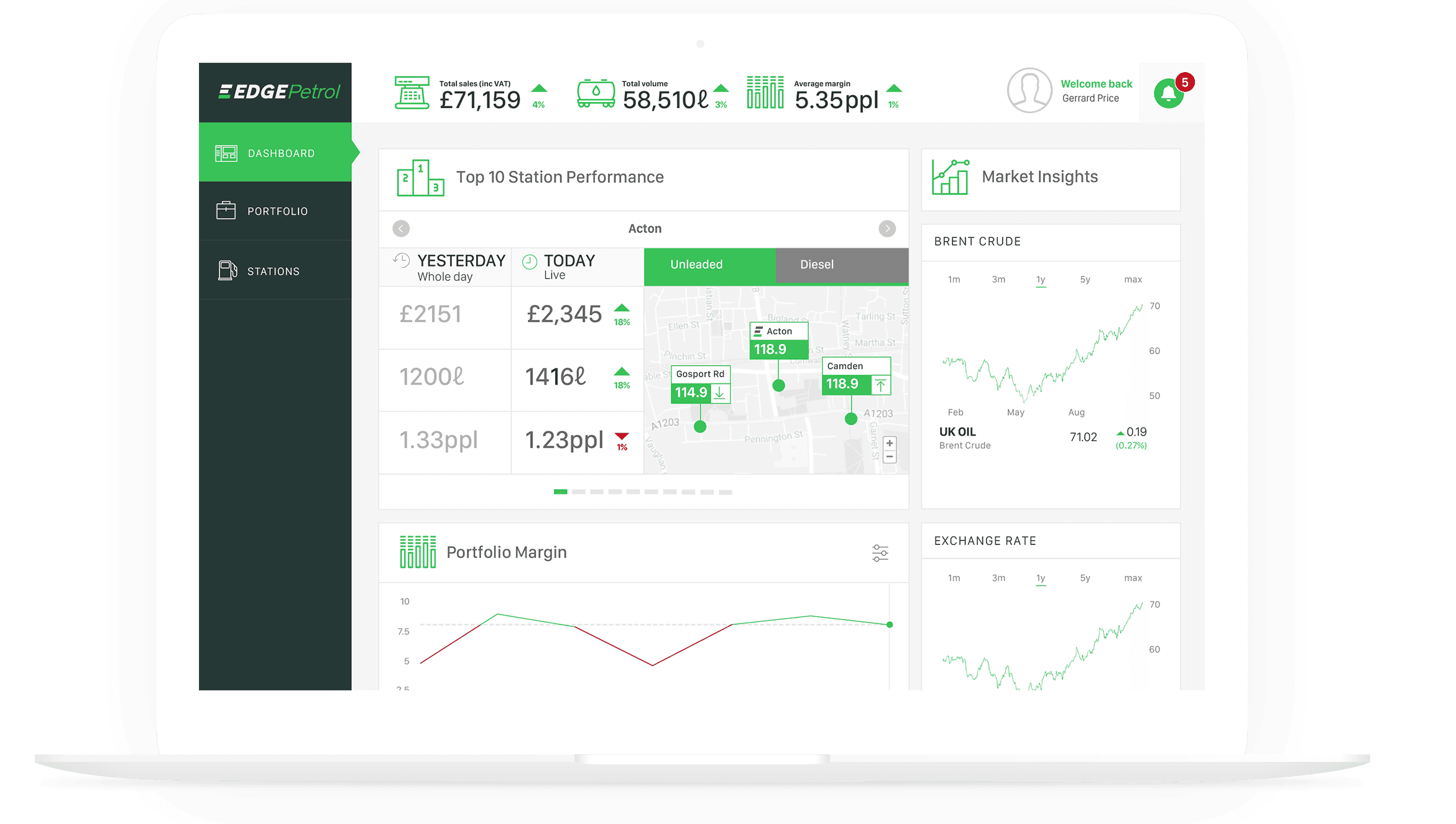
With a fully functioning product, the Edge team focused on boarding new customers and connecting to a growing number of data points across the UK and Ireland. Following the success of the MVP and a proven ROI for its customers, Edge Petrol themselves invited me back to join the team for v1.0 of the app. Armed with three months of user data, new data points and a growing in-house team including data scientists things really got exciting.
- +24%YOY profit increaseAverage for clients who joined before June 2018
- US expansionMarket growthAlliance with Petroleum Equity Group
- Big OilPartnershipDistributing Platts daily price assessments